


You've probably noticed: more and more people ask ChatGPT, Perplexity or Gemini their questions rather than Google. And an AI doesn't send back a list of ten links. It answers, and cites a few sources along the way.
In fact, even Google has joined in: since 22 July 2026, Google Search also shows AI-written answers in France, with AI Overviews and AI Mode (Google's official announcement).
Being one of those sources is what GEO, for Generative Engine Optimization, is all about. With Emanuelle Brusacoram, we built GEOfast, a tool that audits a page and tells you what to fix so that an AI understands it and can cite it. Let me tell you about it!
A duo, two trades
Emanuelle has been working in search marketing since 2001. SEO, SEA, and now GEO: she helps brands, from SMEs to large accounts, stay visible in search engines, both classic and generative. She works under the name L'Emarketing aux Petits Oignons.
As for me, I'm a software architect. My role was to turn her expertise into a reliable tool: a grid of criteria applied identically to every page, reproducible results, and reports that can be passed on as they are to a writer or a client.
That mix is what makes GEOfast: the method of a search specialist, and the tooling to apply it to any page, always in the same way.
What GEOfast actually does
You give the address of a page. In about two minutes, GEOfast analyses it against a grid of just over 30 editorial, structural and technical criteria: whether there is a summary, how the content is split up, FAQ, factual tone, evidence, structured data...
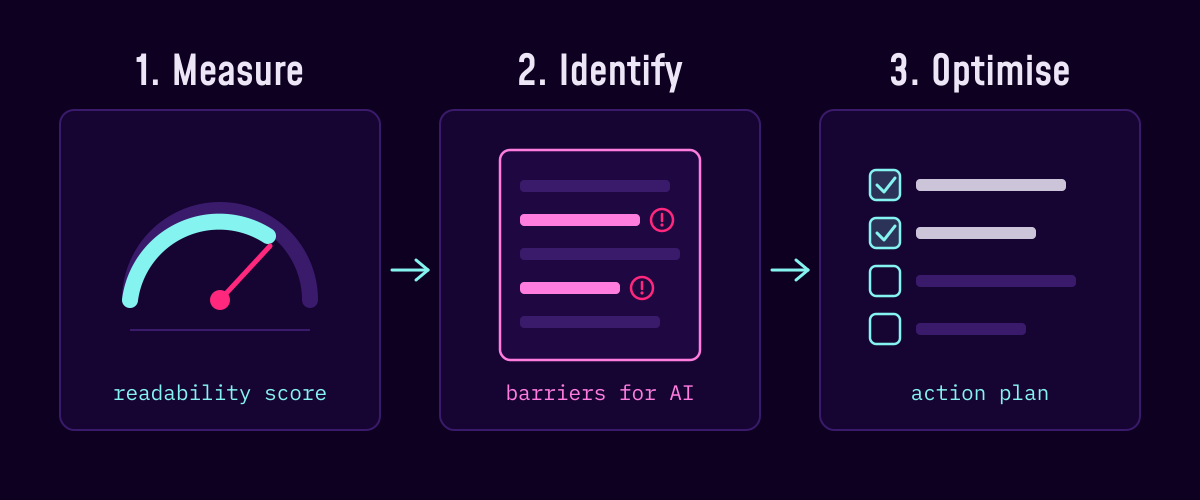
At the end, you get a score, the list of obstacles that stop an AI from using your content, and a prioritised action plan, together with a writing brief for reworking the page. The report can be exported to Excel, Word or PDF, and depending on the plan you choose, it is checked by an expert.
The tool works on blog posts, guides, pillar pages, service pages and e-commerce categories.
And are your pages already cited?
That's often the first question! GEOfast also measures your citation rate in ChatGPT and Perplexity. That way you know whether your pages already appear in their answers, as well as what to fix so that they do.
We apply it to ourselves too
You may have noticed the "In short" box at the top of this article, and the frequently asked questions at the very bottom. They are precisely criteria from the GEOfast grid! Søcle, the platform this site runs on, actually builds them in natively.
Talking about it
Emanuelle and I answered questions from E-Commerce Nation in an interview entitled "GEO: what if AI (finally) talked about you?". You can read the interview on E-Commerce Nation.
GEOfast also has its own startup profile on Les Pépites Tech.
And for those curious about the technical side (Python, Flask, and how to make a language model follow a fixed grid), I've gone into all the details in an article on developpeur-python.com.
How much does it cost?
- Light: free, 5 analyses per month.
- À la carte: €39 incl. VAT (€32.43 excl. VAT) for a pack of 5 analyses valid for one year, with a check by an expert.
- Premium: €79 incl. VAT per month (€65.83 excl. VAT) for 15 analyses per month, with one hour of consulting with a GEO expert.
The simplest thing is still to try the free plan on one of your pages.
Want to be cited by AI?
Run a first audit on geofast.fr. And if you have a project for a custom tool, or for integrating AI into your own software, let's get in touch!