

For years, I've looked after my clients' WordPress sites. Core updates, theme updates, plugin updates, cache settings, backups... and every now and then, a hacked site that needs cleaning up urgently. In most cases, the attack had come in through a plugin or a theme that hadn't been updated in time.
Over time, I asked myself a very simple question: what if a website stayed put until you asked it to change?
That's how Søcle was born, the website platform I build and use for my clients. And for this site, as it happens. Let me introduce it.
WordPress is not the villain of the story
Let's be clear, WordPress is still an excellent tool, and it suits a huge number of projects very well. It's just that for a showcase site or a small shop, it needs upkeep that my clients don't see: keeping up with updates, keeping an eye on security, tuning the cache so the site stays fast, renewing the paid plugin licences every year.
And then there's AI. Today, many people would rather write "add a question about lead times to the FAQ" than hunt for the right block in a page builder. The WordPress admin was designed for clicks, not for this kind of request.
A website you change by asking
With Søcle, you change your site by describing what you want, in plain language, in a chat called Søcle Studio.
The change is never made directly on the live site. It is applied to a private copy, and you get a link to see the result. If you like it, you publish. If not, you cancel, and the live site hasn't moved a pixel. Previous versions can still be restored, just in case.
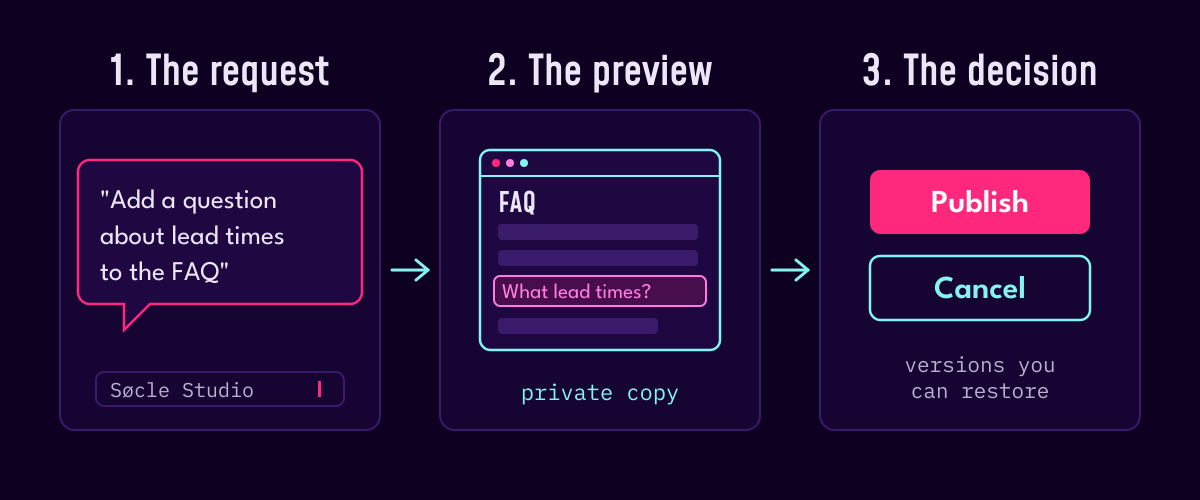
For everyday tweaks, the AI built into the Studio is enough. For bigger jobs, you can plug in your own Claude or ChatGPT through an MCP connector. The assistant then works on the same copy, with the same safeguards: it sees neither the passwords nor the server configuration, and by default you keep the "Publish" button.
I use it myself. This site's new icon, for example, was drawn, checked in the preview and then published over the course of a simple conversation.
What's under the bonnet
On the technical side, this is where the software architect in me had some fun.
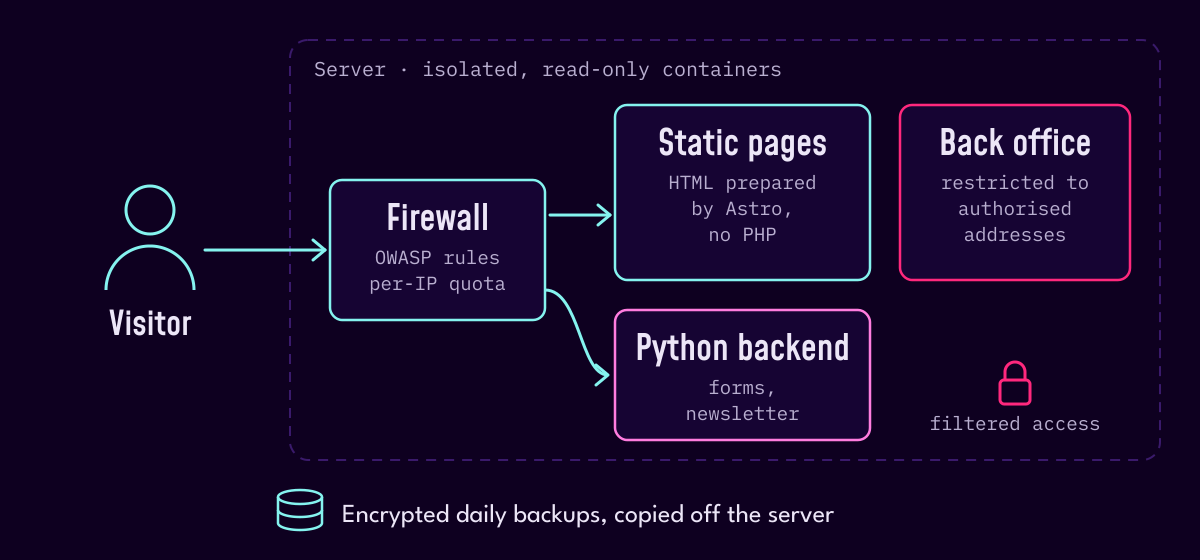
- Static pages: the site is generated with Astro. The HTML is prepared in advance and served as is, with no PHP or database behind the public pages. It's fast, and it leaves far fewer ways in for attackers.
- No plugins: common features (newsletter, FAQ, testimonials, visitor reviews, team, projects...) are "recipes" that the AI installs directly into the site.
- A shop if needed: it is built on Saleor, an open source e-commerce engine, with payment by Stripe, Mollie, PayPal or bank transfer.
- Security in several layers: an application firewall with the OWASP rules, a back office reachable only from authorised addresses, unprivileged read-only containers, encrypted daily backups with a copy off the server.
Search visibility hasn't been forgotten, neither for Google nor for the AI assistants that cite more and more sites in their answers: "In short" summaries, marked-up FAQs, an llms.txt file, 301 redirects... On this subject, I work with Emanuelle Brusacoram, a search expert since 2001, with whom I co-founded the GEOFast audit tool.
You are reading a Søcle website
Le Programmeur used to run on WordPress. It was migrated to Søcle keeping the same page addresses, the same titles and the same descriptions, so as to lose nothing in search rankings. So this article is served by Søcle!
Migration is part of the offer: pages, posts, media, Yoast or Rank Math settings and the WooCommerce catalogue are brought over, and every old address is redirected to the new one.
A human behind the machine
Søcle is not a self-service website builder. I'm the one who builds the site, checks it and puts it online. After that, you make it evolve as if you were writing to your service provider, but you have the final say. As I explained in what cannot be delegated to AI, the machine carries out the work, but someone has to remain responsible for what is delivered. Human support is also available as an option.
The site belongs to you, and you can get its complete static version back at any time. As for budget, building a site starts at €600 excl. VAT, depending on what needs bringing over and the features you want, and hosting from €8 excl. VAT per month, with no plugin licence or maintenance billed separately.
Want to try it?
Fed up with updates, or would you simply like to change your site in one sentence? Everything is explained on socle.le-programmeur.com, and a trial of the platform is available on request. And if you'd like to talk it over in person, let's get in touch!